Ai Interdisciplinary Professional Development · Civic Intelligence
AiiPD converts local government evidence into comparative civic intelligence using the Dynamic Relational Model of Consciousness. We help councils, policy makers, candidates, communities and researchers identify risk, resilience, reform opportunities and public-purpose gaps, with material findings linked to source and verification status.

About AiiPD
AiiPD converts scattered public evidence into integrated civic intelligence. We bring demographic, economic, policy, governance, social impact and community evidence together into one explainable analysis.
The DRMC combines 19 core relational domains with seven applied civic extensions to interpret the dynamic relationships between place, people, institutions, risk, resilience and opportunity, so councils, candidates, communities and partners can see what is happening, why it matters and what can be done next.
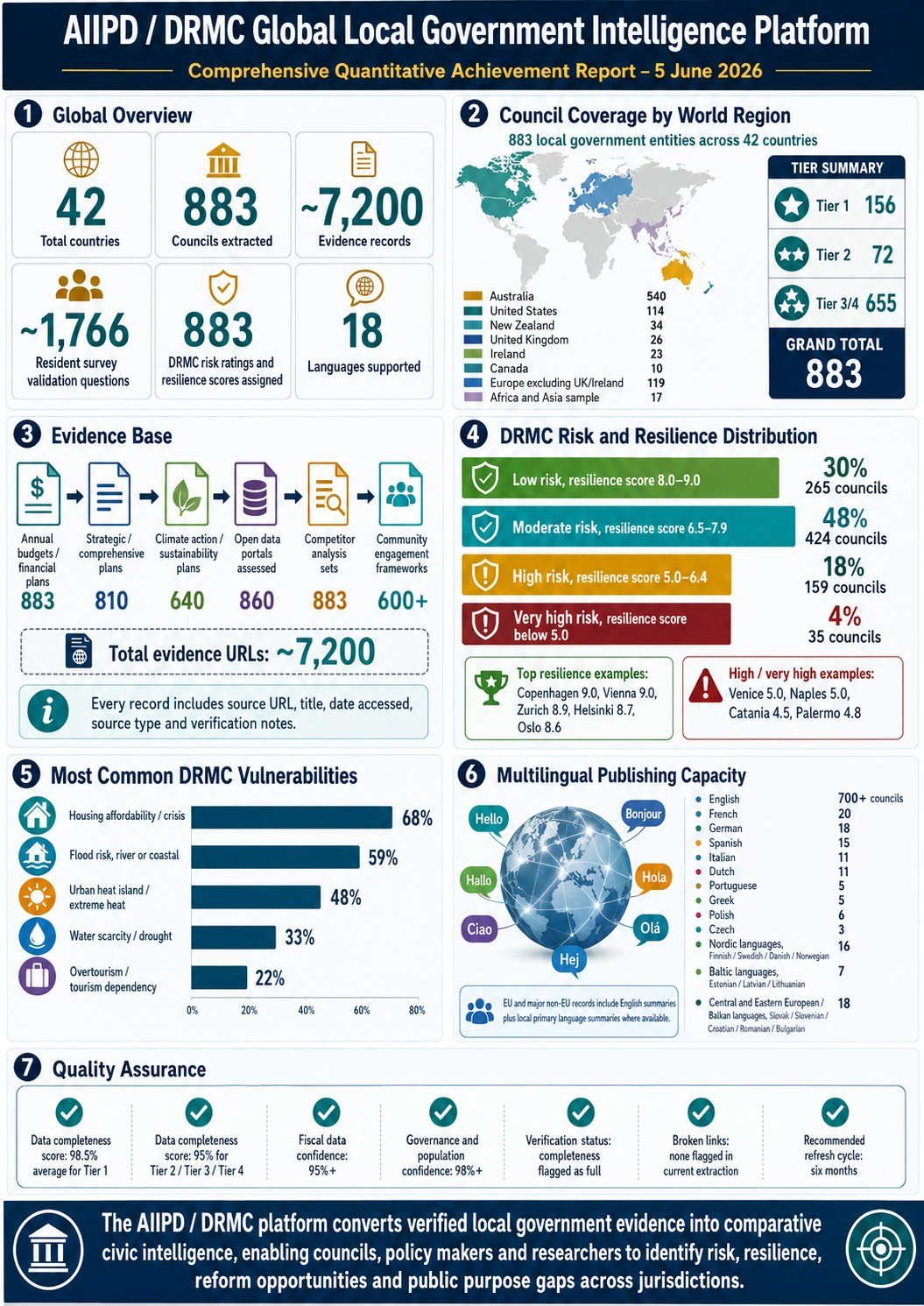
The current platform evidence base covers 883 local government entities across 42 countries, with database synchronisation still in progress. Outputs remain source-traceable and require human review before formal use.
Most civic analytics tools are black boxes: they give you a number and hide the reasoning. The DRMC is explainable by design. Outputs distinguish verified evidence, useful indicators, unresolved gaps and recommended next steps; formal claims require source traceability and human review.
It is positioned as an explainable analytic and decision-support environment, not a pseudo-diagnostic scoring system. That is what makes it credible with councils, universities, NGOs and regulated sectors that need structure, evidence and clear review pathways.
RSC outputs are interpretive assessments, not validated measurements. Clancy, L. (2026i). AiiPD, Adelaide.
Liam Michael Clancy is the founder of AiiPD and developer of the Dynamic Relational Model of Consciousness. His work connects social science, vocational education, civic data, ethical AI, community development and local government benchmarking into practical tools for public-purpose decision making.
The platform is designed to convert public evidence into transparent civic intelligence for councils, candidates, researchers, consultants and community-sector partners, while keeping interpretation source-traceable, reviewable and ethically bounded.
Five integrated functions
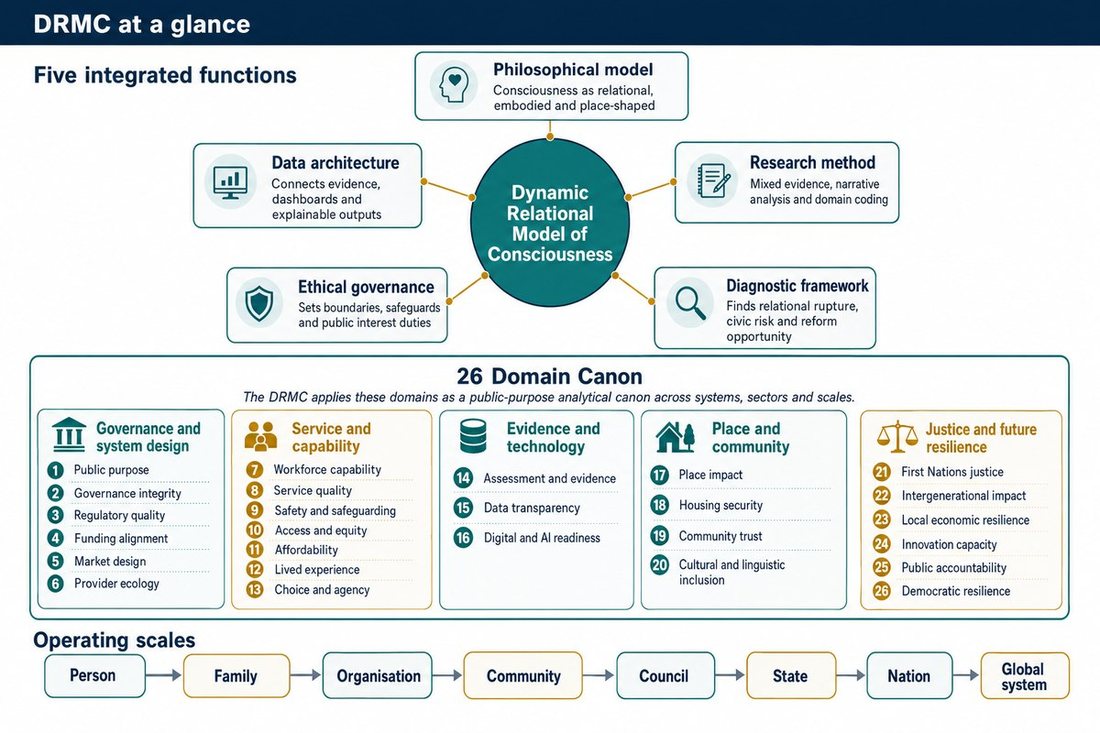
The DRMC is simultaneously a philosophical model of consciousness, a relational research method, a practical diagnostic framework, an ethical governance system and a data architecture that connects evidence, dashboards and explainable outputs.
That integration is the point. The same relational logic that underpins the academic work also drives the civic intelligence products, so the analysis a council receives rests on a coherent theory of how communities, institutions and places actually relate, not a loose bundle of indicators.
It applies its 26 domains as a public-purpose analytical canon across systems, sectors and scales, from the individual person through family, organisation, community, council, state and nation to the global system.

The Intelligence Platform
The AiiPD / DRMC Global Local Government Intelligence Platform converts local government evidence into comparative civic intelligence. Records are governed through source, access-date, type and verification fields; material still under review remains visibly distinct from verified findings.
The platform tracks DRMC risk and resilience distribution, the most common civic vulnerabilities (housing affordability, flood risk, urban heat, water scarcity, overtourism) and multilingual publishing capacity across 18 languages.
Request platform access
Place intelligence map
AiiPD keeps the demographic and economic base visible: population, SEIFA, rent, household income, unemployment and age. The difference is that each place can then connect to social impact, civic risk, resident evidence, source registers and innovation opportunities.
Current public map demonstrates the 13 metropolitan Adelaide cohort while the broader 883-entity database continues synchronising. Missing values stay visible. DRMC outputs are interpretive civic intelligence and require human review before formal use.
Why AiiPD
Profile tools like RemPlan and .id (informed decisions) are strong at economic and demographic data. AiiPD matches them on breadth and goes further on relational depth, evidence traceability, ethics and report automation, with the DRMC as the analytical difference.
Intelligence Centres
AiiPD organises its work around five public-facing intelligence pathways, all grounded in the DRMC and delivered through a structured, evidence-based methodology with human review.
Place intelligence reports, governance reviews, community intelligence profiles, budget impact reports, policy shock reports and resident validation surveys for councils, governments and community organisations.
Compliance readiness reports, evidence registers, policy reviews, audit preparation packs and quality assurance scans for RTOs, NDIS providers, aged care, childcare and human services.
Skills demand reports, course opportunity reports, workforce demand alerts and training publication plans for RTOs, employers, councils and Jobs and Skills bodies.
Candidate intelligence briefs, local area reports, policy position statements and resident listening toolkits. Strictly evidence-based: no misinformation, voter profiling, smear content or covert persuasion.
Applied frameworks for organisations navigating AI adoption, grounded in the DRMC ethics architecture and its dual-use safeguards. What AI actually demands of institutions and communities.
The DRMC Framework
The Dynamic Relational Model of Consciousness maps how consciousness operates across individuals, organisations, communities and systems. Tier 1 covers 19 core domains; extension domains D20 to D26 activate contextually, grounded in the work of Sen, Stiegler, Barthes, Ricoeur, Merleau-Ponty, Bourdieu and Fisher/Ury.
Relational Spectral Coding (RSC) maps relational condition and intensity across six non-hierarchical zones: Disconnection, Compression, Friction, Reflection, Attunement and Transformation. The gradient is an interpretive coding aid, not a ranking of worth. RSC outputs are explicitly distinguished from any future validated Relational Resonance Metrics.
Request a DRMC briefing
DRMC visual framework
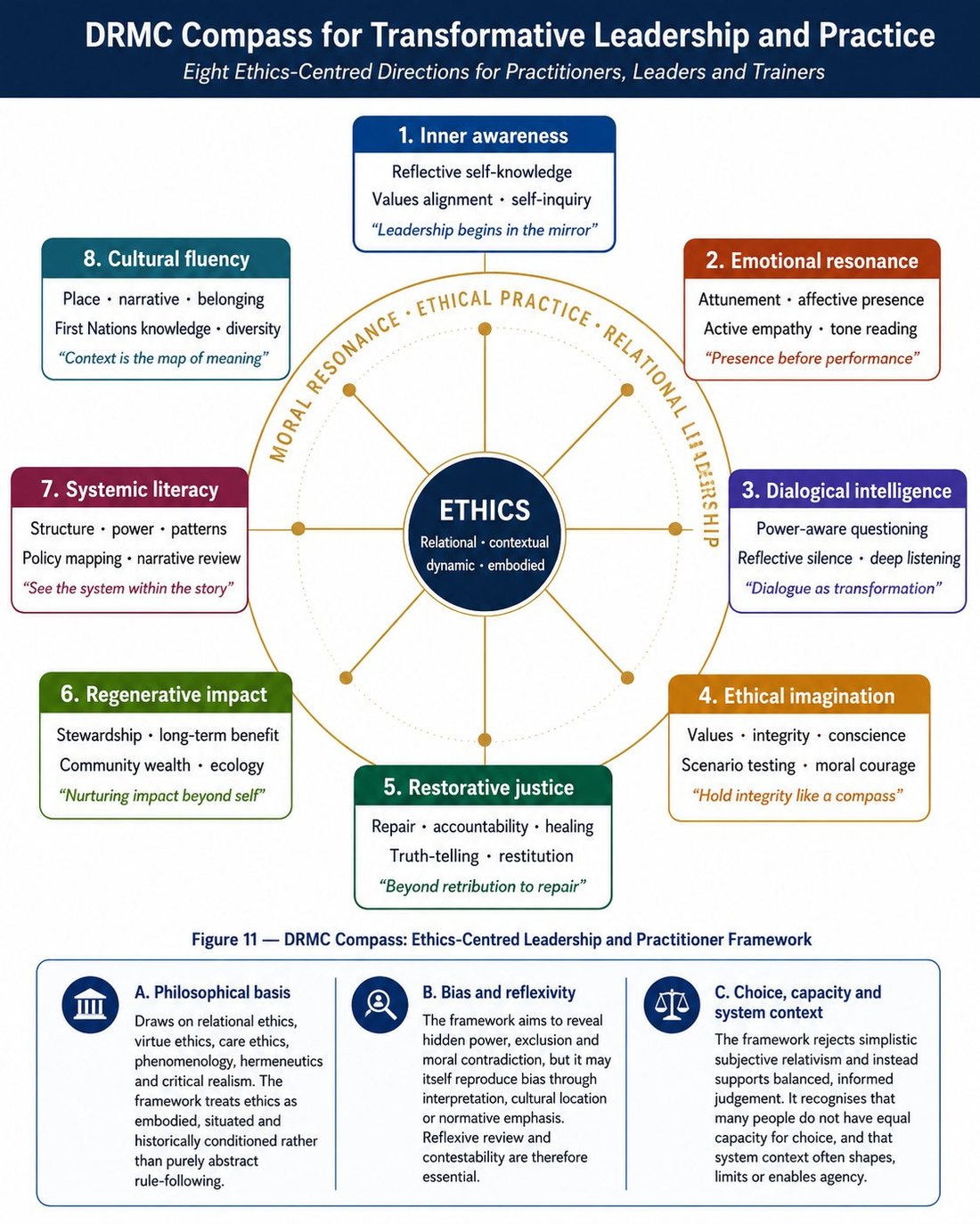
This visual summary shows how the DRMC is applied across local government, education, care, housing, budgets, AI ethics and organisational leadership. It keeps the framework grounded in civic life rather than abstract system language.


Data integration architecture
The DRMC data architecture takes eight input streams, from interviews and surveys through policy documents, social and economic indicators to environmental and sensor data, and passes them through an interpretation middleware into the DRMC core model.
The core model runs the 19-domain relational matrix, RSC frequency coding, co-activation mapping and visualisation. Human review is required at every interpretive stage. This is what produces analytical outputs that are auditable rather than opaque: radial domain profiles, narrative field maps, assurance dashboards and contestable, public-facing assessments.
It is the architecture that lets AiiPD match the data incumbents on breadth while exceeding them on explainability and relational depth.
For Council Candidates
Selling to councils takes time: procurement, committees, budget cycles. But every council election brings thousands of candidates across Australia, and each one needs credible, evidence-based local intelligence, fast. AiiPD is built to be the essential intelligence partner for every one of them.
This is the ethical version of political intelligence. We provide verified local data, issue summaries, First Nations Country and Community Context and policy position support. We do not do voter profiling, misinformation, smear content or covert persuasion. The DRMC Ethics Guide prohibits all of it. That boundary is exactly what makes the product durable.
A massive market, near-term revenue, and a warm pathway into every council area in the country.
See candidate productsNew Capabilities
Our database now prepares economic profiles and development options for councils, grounded in ABS resident data, REMPLAN place-of-work figures, the DRMC layer scores and the benchmark cohort.
Each opportunity is scored on need, readiness, DRMC leverage, precedent strength and council actionability, with evidence and an implementation pathway. Best-practice, justifiable, budget-defensible decision support, the kind of analysis a council can actually take to a meeting.
We help property developers identify genuine development opportunities. More importantly, we offer real engagement services whose legitimacy can be measured.
Using DRMC relational analysis, we trace and report the actual level of deliberative democracy a process demonstrates, not just that consultation happened, but whether it reached the relational conditions that produce legitimate, trusted decisions. In a market full of engagement theatre, that is a genuine difference.
Products & Samples
AiiPD produces a tiered suite of intelligence products from its governed evidence base. Below: flagship products, plus downloadable samples ranging from full-text reports to index-and-introduction previews and individual sample sections. Complex reports are scoped before pricing.
Comparative governance, finance, infrastructure, engagement and place analysis for a single council against a peer cohort, with DRMC layer analysis and a full verified evidence register.
A searchable pathway into economic and civic opportunity examples, linking local evidence with comparable precedents and DRMC layers.
Translates Federal, State and jurisdictional budgets into targeted implications for a council, RTO or community: infrastructure, housing, climate, cost-shifting and service pressure, with confidence ratings.
The complete integrated economic and social development review for the City of Holdfast Bay: a full worked example of an AiiPD place intelligence briefing using DRMC and current ABS evidence.
A real Phase 1 register: 10 scored opportunities with DRMC layers, evidence, precedents and implementation pathways, generated from current AiiPD and ABS data.
The contents, executive overview and introduction to the full DRMC Overview: the pluralistic framework for consciousness, place, ethics, information, agency and systemic transformation.
Digital documents and toolkits for RTOs, NDIS, aged care and childcare providers, with implementation support quoted separately. Powered by the AuditReady and EvidenceMapper modules.
Local issue summaries, evidence briefs and policy position drafting for candidates and civic leaders, with First Nations Country and Community Context and strict ethical boundaries.
Structured professional development covering DRMC foundations, RSC interpretation, applied domain analysis and ethical practice, toward AiiPD practitioner certification. Delivered via the LMS.
Innovation Finder
Start with the preloaded Holdfast Bay examples, then expand into the global council database as more records synchronise. Results show the opportunity, DRMC layers, confidence and precedent logic so users can move from map context to practical comparison.
Loading innovation examples...
Shop
Filter by sector, then request a defined template or pack, or scope consulting work that needs proper review. Direct checkout will be enabled only when the production Stripe catalogue is configured.
Comparative governance, finance, infrastructure, engagement and place analysis for one council against a peer cohort, with full DRMC layer analysis and verified evidence register.
Scored, ranked shortlist of economic development opportunities generated from a council's own ABS, REMPLAN and DRMC data, with evidence and implementation pathways.
Translates Federal, State and jurisdictional budgets into targeted implications for a council, RTO or community, with confidence ratings on every claim.
Digital evidence pack for grant preparation: need statement, evidence register, policy alignment map, social impact narrative and evaluation framework. Consulting support is POA.
A ready-to-run resident survey instrument with DRMC-aligned question sets, analysis guide and reporting template. Tailored council questions and implementation package available from $49-$649.
Digital audit toolkit to test whether engagement is substantive or theatre, using DRMC relational indicators before a project goes wrong. Implementation consulting is POA.
Evidence-based local intelligence for a council candidate: local issue summaries, verified data, State and Federal budget impact statements, First Nations Country context and contacts, a key community stakeholder list, and policy position support. Strict ethical boundaries.
A structured local area evidence report for a single ward or council area: demographics, key issues and verified sources.
A practical digital toolkit for candidates to gather and structure genuine resident input without manipulation or profiling.
Convert existing training material into structured, RTO-2025-aligned course content with evidence mapping.
Document pack introducing RTO 2025 audit preparation, evidence registers and compliance gap scanning aligned to the 2025 Standards for RTOs.
Digital audit readiness toolkit covering assessment validation, sampling plans and continuous improvement workflows for RTOs. Supported external audit support starts from $1,500.
Practical support for organisations preparing for external audit, including evidence review, readiness coaching and implementation support. Scope depends on the audit context.
A ready-to-adopt policy document for AI use and academic integrity in vocational education. Single policies are $9; branded complete policy sets are $649 with appropriate disclaimers.
Person-centred relational practice aligned to quality standards, inclusion and governance. Introductory prospectus.
A DRMC-informed support planning template for NDIS and aged care providers.
Drafting toolkit for incident and complaints response aligned to NDIS and Aged Care quality standards. Governance support, not clinical instruction.
Responsible AI policy, governance workflow, human-in-the-loop controls and bias-and-transparency audit guidance, grounded in the DRMC ethics architecture.
A ready-to-use AI use register for organisations needing to document and govern their AI deployment.
A self-paced or facilitator-led staff training module on responsible, evidence-aware AI use.
Digital toolkit to turn disorganised community feedback into structured, defensible themes with DRMC relational coding. Customised implementation is available from $49-$649.
Report and evidence the actual deliberative legitimacy of a decision process, not just that consultation happened.
Digital toolkit to monitor community engagement fatigue and trust over time using DRMC relational indicators. Customised implementation is available from $49-$649.
The full 26-domain DRMC SIA methodology: reflective, culturally aware impact assessment that produces evidence-supported analysis.
Build a clear, funder-ready theory of change with this structured visualisation workbook.
An impact reporting template designed to satisfy funders and boards, with DRMC indicator integration.
A practical, professional guide to using Claude for research, product development and evidence-aware work.
How to combine Claude, ChatGPT, Gemini, DeepSeek and Perplexity in a professional, ethical consulting workflow.
Structured professional development toward AiiPD practitioner certification: DRMC foundations, RSC interpretation, applied analysis and ethical practice.
Learning Community
The AiiPD learning community will connect DRMC foundations, RSC interpretation, council benchmarking, report review and ethical AI-assisted analysis into a structured Moodle pathway.
This public site now exposes the pathway and registration point. The full LMS dashboard will be linked here once enrolment, access control and course publishing workflows are ready for production.
How-To Guides
New to AiiPD or the DRMC? These quick guides walk you through choosing a product, buying it, reading a report and commissioning bespoke work. The full How-To Guides are available as a downloadable PDF.
Whether you are a council, candidate, RTO or care provider, find the right starting point for your need and budget.
How instant Stripe checkout works for templates and toolkits, and how bespoke consulting products differ.
Understand verified evidence, indicators, gaps and the RSC zones, and why the caveat matters.
The five-step process from enquiry to scoped proposal to a delivered, human-reviewed report.
Adapt templates to your context while keeping the structure and evidence discipline that make them defensible.
How eligible First Nations organisations access and use the free licence, with authority retained.
News & Insight
Policy commentary, budget impact analysis, framework thinking and civic intelligence insight from Liam Clancy and AiiPD. Published in full on the OzWizard Substack.

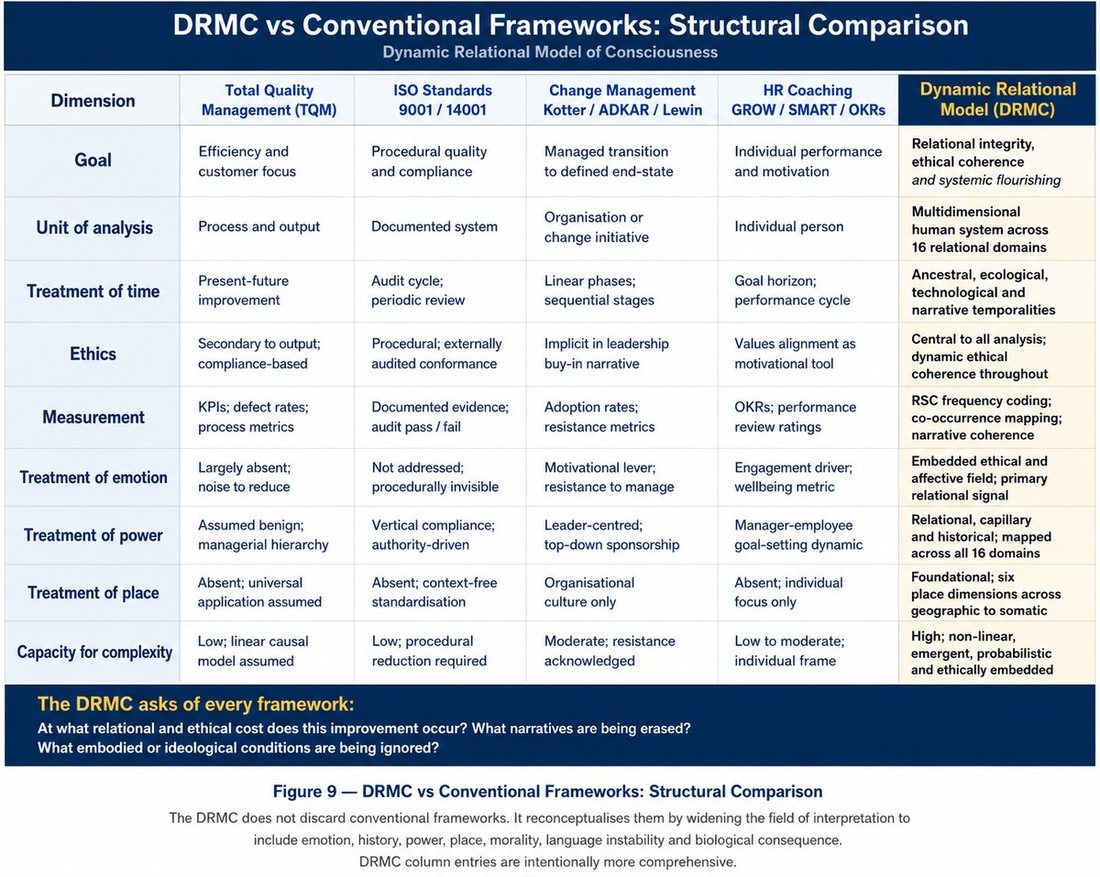
Most council engagement fails not because communities are difficult, but because the process never touches the relational conditions that actually drive trust. The DRMC names what conventional frameworks miss, and shows where engagement breaks down before a project does.

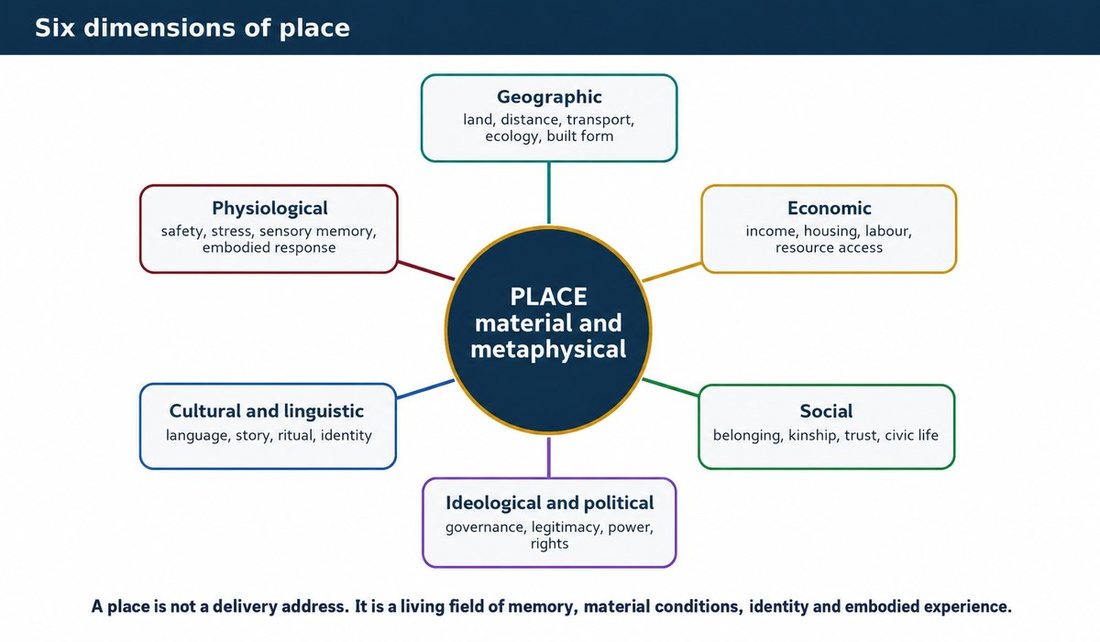
Place is a living field of memory, material conditions, identity and embodied experience, geographic, economic, social, cultural, linguistic and ideological all at once. When budget impact reviews ignore that, they misread how a policy will actually land in a community.

Comparison exposes the claim of inevitability. When you can benchmark housing stress, flood risk and governance resilience across jurisdictions, market-led reforms stop looking unavoidable and start looking like choices, with better models already operating elsewhere.

Most AI ethics frameworks ask what a system should be allowed to do. The DRMC asks a harder question: what kind of relational consciousness are we building into our institutions when we automate them? Ethics here is constitutive, not advisory.
Our Method
Every AiiPD output follows the same disciplined method. We make weak evidence visible rather than smoothing it into a score, and sensitive interpretation is reviewed by people with the right authority and context.
Clarify what the council or client actually needs to decide, explain or improve. Not every question needs a benchmark; some need a workshop or a straight advisory opinion.
Use public documents, datasets, engagement records and local context. Every claim traces to a source type, publication context and verification status.
Apply domain analysis across governance, finance, engagement, place and narrative. Identify patterns without pretending uncertainty has disappeared.
No automated output becomes final without analyst review, a named reviewer, version control and a caveat block. Then deliver client-ready reports, briefs and workshops.
A decision-support tool, not a substitute for governance, professional judgement or community consent. AI does not make final civic, ethical or regulatory judgements.
First Nations Country and Community Context
AiiPD recognises that every council area exists on Country.
For this reason, AiiPD intends that every council profile, candidate briefing, mayoral briefing and civic intelligence report will include a First Nations Country and Community Context section wherever relevant public information is available. This may include publicly available information about Traditional Owners, Country, language groups, council Acknowledgements of Country, Reconciliation Action Plans, First Nations organisations, cultural heritage, colonial dispossession, local history, frontier violence, survival and current community priorities.
This material is public-source civic context. It is not cultural verification. AiiPD does not speak for Traditional Owners, Elders or First Nations communities. Where material has not yet been reviewed by appropriate cultural authority, it is marked:
AiiPD welcomes correction, restriction, verification and feedback from Traditional Owners, Elders, First Nations organisations and Aboriginal and Torres Strait Islander community representatives. First Nations authority remains with First Nations people. We do not expect Elders, researchers or cultural advisers to provide unpaid cultural labour: where cultural review, Yarning Circles or community validation are requested, those contributions should be properly funded.
AiiPD is making a free licence pathway available to eligible First Nations organisations, Elders groups, Local First Nations Voice structures and Aboriginal community-controlled organisations that wish to use the database and report structure for their own work.
The licence can be free, but setup, local engagement, cultural review, hosting and operational costs need to be funded through councils, grants, government programs or Indigenous-led product development. First Nations people retain authority over First Nations content, cultural interpretation and community validation.
Enquire about the free licenceWho we work with
Council executives, mayors, councillors, governance staff, finance teams, strategic planners and engagement teams across Australia and internationally.
Aged care, NDIS, child care and community service providers navigating AI adoption, compliance, quality improvement and governance accountability.
Registered training organisations, vocational educators and workforce planners building AI-aware curriculum, compliance systems and capability.
Not-for-profit boards and community development teams working on social impact assessment, engagement design and governance improvement.
Candidates, councillors and independents needing evidence-based local intelligence within strict ethical boundaries: no manipulation, no voter profiling.
Aboriginal community-controlled organisations, Elders groups and Local Voice structures using the free licence pathway for their own accountability and truth-telling work.
Membership
Membership connects public resources with sourced council profiles, the protected Civic Intelligence Workspace, report drafts, learning modules and partner pathways. Operational and private functions remain role-controlled.
For people reviewing AIIPD, accessing free resources and following the public development of DRMC civic intelligence.
For council watchers, consultants, candidates and researchers who want regular briefings and practical digital products.
For practitioners who need stronger access to benchmarking, templates, training and report production support.
For councils, universities, consultancies, First Nations organisations and sector partners seeking team access or white-label pathways.
Get involved
Choose a membership level, partnership pathway or licence option and register your interest below. We will respond personally; this is not an automated funnel.
Get civic intelligence briefings, budget impact updates, new sample reports and OzWizard insight direct to your inbox. For council officers, researchers, candidates and the civic-curious.
Create free accountCo-develop intelligence products, research partnerships, pilot deployments or co-branded reports. For councils, universities, consultancies and sector networks.
Explore partnershipLicence the DRMC framework, the database structure, white-label publishing or the certification pathway. Free licence pathway available for eligible First Nations organisations.
Discuss a licenceCreate a free account to save councils and use the member workspace. For a council pilot, partnership, professional deployment or licence, use the structured scoping pathway so the request enters the back-office workflow.
Prefer email? liamclancy@aiipd.com.au
Get in touch
AiiPD welcomes enquiries from councils, human services, education providers, NFPs, First Nations organisations, candidates and researchers. Whether you want a benchmark report, a budget impact analysis, an AI ethics workshop or a conversation about what the framework can do, we want to hear from you.
Email: liamclancy@aiipd.com.au · Web: www.aiipd.com.au · Substack: www.ozwizard.substack.com · Glenelg, South Australia
Free resource access
Enter your name, phone and email so AiiPD can send follow-up resources, campaign updates and corrections where needed.
Public correction pathway
Use this form for data corrections, broken links, cultural concerns, translation issues or general feedback. Do not submit private, sacred or restricted cultural knowledge.